As an Amazon Associate I earn from qualifying purchases

Tuesday, April 13, 2021

The TFS Audacity

The Free Ship (TFS) Audacity under the command of Lady Helen Quartermain.

Following the destruction of the Weldon Institutes dirigible Go-Ahead by Robur the Conqueror and his airship the Albatross, the small aerial fleet of the United States engaged the Albatross near Philadelphia, PA.  Though the Albatross was defeated and severely damaged, it escaped and the ship responsible for the victory was the privateer TFS Audacity, under letters of marque, commanded by Lady Helen Quartermain.  

The Albatross.

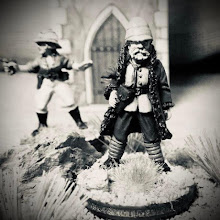
Lady Quartermain and some of the crew of the TFS Audacity.

With the expanded rules for airships in the Second Edition of In Her Majesty's Name, I thought it was about time I finished painting my airship. It was the first MDF model I did and I learned a valuable lesson: PAINT THE PARTS BEFORE ASSEMBLY! Good lesson learned. Anyway . . . the TFS Audacity is painted and ready to fly. Rules for Lady Helen Quartermain and crew can be found in the Second Edition of In Her Majesty's Name.


"Da, she's not a pretty ship. But she'll put the fear of the Lord in the hearts of her enemies", Chief of Boat (COB) Sergey Rozhenko in discussing the TFS Audacity to some potential "clients" on behalf of Lady Quartermain.

The guns and machine guns came from Pulp Figures.


The airship kit is the Mozzy Class Airship from Crossover Miniatures. Extremely clear instructions, all of the parts fit and it was fun to put together - and I'm not good with models! It was a gift from Honorable Sons #1 through #5 and I was happy that they also purchased the very sturdy display base to go with the ship.


Taking on supplies in Chaimbellistan.


Saturday, April 10, 2021

The Royal Fusiliers (City of London Regiment)

First of all, let's get all of the disclaimers out of the way:

1. I know the British Indian Army did not have shorts during the period of the Anglo-Russian War (or did they?).

2. I wanted a British unit with Wolseley helmets for The Men Who Would be Kings! Wolseley helmets are cool.

3. The Lewis machine gun is a filler for the issue I discussed earlier with Copplestone packaging in their Back of Beyond range. The Lewis will be used in other campaigns to come.

4. I'm playing with Toy Soldiers. Now that it's all cleared up, on with the show! (BWAH HAH HAH!)

One of the oldest Regiments in the British Army, it was formed as a fusilier regiment in 1685 by George Legge, 1st Baron Dartmouth, from two companies of the Tower of London guard, and was originally called the Ordnance Regiment. Most regiments were equipped with matchlock muskets at the time, but the Ordnance Regiment were armed with flintlock fusils. This was because their task was to be an escort for the artillery, for which matchlocks would have carried the risk of igniting the open-topped barrels of gunpowder.

       
For our period, the single-battalion Regiment embarked for Scutari for service in the Crimean War on 5 April, 1854 (with the Depot at Winchester), and saw action at the Battle of Alma in September 1854, the Battle of Inkerman in November 1854 and the Siege of Sebastopol in winter 1854. The newly re-formed 2nd Battalion, which had been at Preston, embarked for Gibraltar on 27 May, 1858; but we are only going to concern ourselves with the 1st Battalion. 

Cap badge of the Royal Fusiliers

In 1865 it was at Ferozepore. It returned to Britain from India on the 27 December, 1870. It embarked for Gibraltar in 1885, and in 1886 and 1887 was at Egypt. From 1888 'til 1901, it was posted to various locations in India, including Poona, Karachi (now in Pakistan), Mhow, Nusseerabad, Bombay, Quetta, Bengal, Neemuch, and Nusserabad. As one of the most experience units in the British Indian Army, it will play a key role in the Anglo-Russian War.


Needless to say, The Royal Fusiliers will be classified as Regular Infantry for The Men Who Would be Kings; and depending on the scenario, may even be classified as Elite due to their experience in India and the scenario.

Officers of the Royal Fusiliers in 1904 at Tucker's Town, Bermuda. Note the variety of headgear. You know what they say, if two regimental officers show up wearing the same uniform, one of them is out of uniform!

Major Elliott Naple-Cooper Stone. Hopefully he will roll well for his Leadership Value and Leadership Trait.

"Steady boys", exclaims Sergeant John Molyneux.

"We'll give those Russians 'What for'".

"Honi soit qui mal y pense!"


Thursday, April 8, 2021

Provisional Rifle Corps: Morgan's Sharpshooters

American riflemen and Daniel Morgan; all figures by Perry Miniatures.

Perfect for Rebels and PatriotsMorgan's Riflemen or Morgan's Rifles, previously Morgan's Sharpshooters, and the one named Provisional Rifle Corps, were an elite light infantry unit commanded by General Daniel Morgan in the United States Revolutionary War, which served a vital role executing his tasks because it was equipped with what was then the cutting-edge rifle instead of muskets, allowing superior accuracy at an up to ten times the distance of the typical troops of the day. 

The disadvantage of the rifle is that they were individually made by craftsman, and due to the rifling of the barrel, a bayonet could not be affixed giving a disadvantage against British troops or Loyalists armed with the bayonet. Most riflemen carried tomahawks and hunting knives for use in close combat ambush opportunities.


Daniel Morgan got his start in the Revolutionary War in 1776 as the Captain of a small rifle unit set up by the state of Virginia, one of 10 such units commissioned by Congress. Morgan's had 69 men, and quickly got the nickname Morgan's Sharpshooters. Morgan's most significant action in this period was support for the invasion of Canada, and the Battle of Quebec in which he was seen as a hero, despite General Benedict Arnold's overall failure and their subsequent capture. The novel Arundel, by Pulitzer Prize winner Kenneth Roberts does an excellent job of detailing the hardships of the Quebec campaign.


In early 1777, when Morgan was freed from captivity, he was commissioned as a Colonel and assigned command of the 11th Virginia Regiment, and a few months later was also instructed by George Washington to form a Provisional Rifle Corps, men skilled with the use of the long rifle, from his and other nearby regiments.

Having done so, his first assignment was to harass General William Howe as he retreated through New Jersey. Morgan did so by having his 500 riflemen snipe the enemy troops as they moved, using their longer range to do so from safety, an unusual tactic for that day. 

Sent to join the northern army headed by General Horatio Gates, Morgan's Riflemen helped establish better conditions for the coming Battle of Saratoga, by a series of quick attacks on their Indian allies, driving them back in order to interfere with British intelligence of the American troops' movements.


His Riflemen proved pivotal in several engagements, including driving back an advanced unit all the way to the enemy's main forces, and later helping turn the main battle by attacking from the right flank, and is credited with forcing the British retreat. In his sequel to Arundel, Kenneth Roberts chronicles the Northern Army in A Rabble in Arms.


After a series of similar successes, Morgan left active service for a year, then joined the southern army with Nathaniel Greene. There his Riflemen's string of successes were capped when they were again pivotal in a key victory, the Battle of Cowpens. 

Facing a superior British line commanded by Colonel Banastre Tarleton, they met it head-on to fire three rounds (before the marching British muskets were in range), conducting a planned withdrawal to another location and duplicating the effort, then joined the main force against the now-depleted and disheartened British lines, who quickly fell into retreat. This was seen as the worst British defeat since the battle at Saratoga, both victories credited to Morgan's Riflemen and described as key turning points in the war. 

Though classified as Continental Regulars Rebels and Patriots, their unique way of fighting, and lack of bayonets, I have decided to mount the Riflemen in the alternative basing of "3", "2", "1" which I feel gives a better esthetics to the unit on the tabletop.


Great figures from Perry Miniatures and a delight to paint and develop "vignettes" with the basing.

The complete unit of 12 which can also be broken into two 6 figure units. A very versatile unit that can also be Light Infantry and Skirmishers.


Monday, April 5, 2021

The Royal Regiment of Chaimbellistan

The Royal Regiment of Chaimbellistan led in theory by Maharaja Tukoji Rao II Holkar but in reality tactical decisions are made by Colonel of the Realm James Bartholomew Crochet.

The Princely State of Chaimbellistan is ruled by Maharaja Tukoji Rao II Holkar during the events of the Anglo-Russian War. A princely state, also called a native state, feudatory state or Indian state (for those states on the subcontinent), was a vassal state under a local or indigenous or regional ruler in a subsidiary alliance with the British Raj. The predominant usage of the term princely state specifically refers to a semi-sovereign principality on the Indian subcontinent during the British Raj that was not directly governed by the British, but rather by a local ruler, subject to a form of indirect rule on some matters. 

Maharaja Tukoji Rao II Holkar and his sister Princess Sita Devi.

The imprecise doctrine of paramountcy allowed the government of British India to interfere in the internal affairs of princely states individually or collectively and issue edicts that applied to all of India when it deemed it necessary. Foreign policy was controlled by the British Raj.


The Princely State of Chaimbellistan relies militarily on the British Raj, but it does have its own army consisting of the Royal Regiment, the 1st (Swords of Justice) Regiment, and the 2nd (Thundering Herd) Regiment. In addition, the Maharaja can call up "militia", some irregular cavalry, and tribal units.


For The Men Who Would be Kings the Royal Regiment will be a unit of Irregular Infantry; however they have been trained well, have "seen the elephant", and are under the eyes of their Maharaja - not to mention Colonel of the Realm James Bartholomew Crochet. As a result they will be a Veteran Unit raising their Discipline to +1 at a cost of one point. Total Point cost: 5. In addition I have developed some optional rules for the Royal Regiment:


Captain James Bartholomew Crochet was with the 39th Garhwal Rifles when he lost his right hand during the First Mohmand Campaign. Deemed unfit for active service, he was placed on half pay; however, his reputation of a trainer of men caught the ear of Maharaja Tukoji Rao II Holkar and he was made Colonel of the Realm and Chief of Staff of the Chaimbellistan Army. He was also an early advocate for the British Army to adopt shorts.


Optional Rule
: When rolling for Leadership Value, Colonel Crochet will never have higher than a 6+ unless a Leadership Trait changes it. If Colonel Crochet ever fails to Rally The Royal Regiment, the Maharaja will take over and you must immediately roll for his Leadership Value and then Leadership Trait. If there are any casualties, you must test for the Colonel first and then the Maharaja. If the Colonel is a casualty, the Maharaja takes over. If the Maharaja is a casualty, then . . . 


Optional Rule
: If The Maharaja is a casualty and Colonel Crochet is still alive, 
Princess Sita Devi replaces the Maharaja at no cost (she was in disguise). If Colonel Crochet ever fails to Rally The Royal Regiment, the Princess will take over and you must immediately roll for her Leadership Value and then Leadership Trait. Only roll for leadership casualty if she is in charge. If she is a casualty, Colonel Crochet resumes command.


Sunday, April 4, 2021

He Has Risen! He has Risen Indeed!

 Resurrection


John 11:24-26 New International Version (NIV)

24 Martha answered, “I know he will rise again in the resurrection at the last day.”
25 Jesus said to her, “I am the resurrection and the life. The one who believes in me will live, even though they die; 26 and whoever lives by believing in me will never die. Do you believe this?”