As an Amazon Associate I earn from qualifying purchases

Tuesday, September 24, 2024

Setting up the Play Test for "Pulp!" (originally published 10/10/23)


The Mad Guru is back and not a sign of the Sergeant's Three to stop him now. Rumor has it that he is in some mysterious temple with an ancient artifact to make the Thugee Cult even more powerful . . .

"I have located the Lost Temple that supposedly the Mad Guru is marshaling his forces and preparing some devilish surprise for the British Raj," exclaimed Colonel (Retired) Douglas, DSO, CBE, etc., as he rushed into the cabin of Captain Ridgewell Hawkes of the 19th Punjabis.

"Well. Quite. Hmmm . . . bloody nuisance," said the good Captain.

"I will cut out his heart and !@&#* to his !@&#*", Princess Sita Devi icily replied.

"Princess," Colonel Douglas continued, "This is a family oriented blog and is rated PG." Plus who will get us there?"

As if on cue, (or a result of watching too many movies) a man shaped shadow grew and cast itself upon the heroic trio. "I will."

"Who the blazes are you?" gasped Captain Hawkes.

"He's The Bat," answered Colonel Douglas.


It's time to play test Pulp! and though I don't want to jump to conclusions, it would be nice if there were quick reference sheets (QRS) or Character rosters to easily reproduce and use. If I was a betting man, based on the zero playing aids under the Pulp! listing on the Osprey game resources page, I'm guessing Osprey is not going to be committing many resources for the game. I am spending way too much time preparing for the game creating my own QRS and Character rosters. The good news, once they are done, they are done and reusable. I'm primarily using Excel, PowerPoint and my good ole copier. In addition, I did not want this playtest to be the generic, vanilla characters that are recommended for beginners. I'm an experienced gamer and we need some HEROIC ACTION AND VILLANY.

Anyway . . .

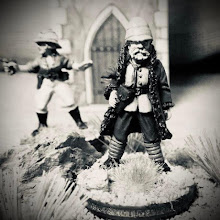
Our adventure is going to feature the return of one of my favorite figures, the Mad Guru from Pulp Figures which is based on the Guru from the movie Gunga Din and sculpted by the talented Bob Murch. Leading our heroes to the mysterious ruins is The Bat - the British Raj version that is blatantly based on a certain caped crusader in America. What the heck is the Mad Guru up to? That's what our heroes need to discover, except for Princess Deva who only has revenge on her mind. 

Here's the line up:


For the good guys we have a 1 figure Superhero unit, a 1 figure Hero unit , 2 x Single figure Elite units, and 2 x 3 figure Seasoned units giving a total of 10 figures to halt the mischievousness of the Mad Guru. Speaking of the Mad Guru:


If the Hypnotic Gaze inflicts an unsaved hit, it causes no suppression or wounds; but, The Mad Guru controls the target for the next turn. The figure will still activate when it unit does, but the Mad Guru will decide what the figure's Action is and resolve it (BWAH HAH HAH!). 


Big, bad and mean - a mercenary after a sorts though he is taking no pay from the Mad Guru. He may take other things . . .


For the forces of evil (BWAH HAH HAH!) there are 1 villain figure units x 2, 1 elite unit with Trainer and poisonous snake, 1 elite unit with 1 figure and 2 Seasoned units with 3 figures each. This gives the forces of evil (BWAH HAH HAH!) also with 10 figures to ruin all that we hold dear.

Now that we have all of our characters for their starring roles in "The Shadow of The Bat, it's time to develop (I kinda have an idea) the scenario and get the playing fields of India set-up.

Thursday, September 19, 2024

Osprey's Pulp!: A Reading Review (originally published on 8/15/23)

 With the "Year of Travel" my painting productions has slowed down quite a bit. While I catch up, I'm going to repost about the game Pulp! which I have learned to love. These are all from last year:


"Okay you dirty rat about Pulp! What's the verdict?" 


Actually I'm not sure. I love the Osprey Wargames 64 page format games and I love Hollywood skirmish gaming so let's take a read of Pulp! by Marco Arnaudo.


Wow. That's some teeny, tiny font. I need to run upstairs and get my reading glasses and another Osprey Wargames book to compare. (Pause) There, that's better. Hmmm . . . yep. That's some teeny tiny font and smaller than previous games I have purchased. Oh well, more bang for the buck.

Hmmm . . . first impression. I really need to change my style of reading. I started scanning through the book and not really doing a deep dive. I need to put it down and read it tomorrow - especially when I'm not tired.


Okay. Let's read from the beginning again.  A Pulp game has to be able to cover a wide variety from crime thrillers, to space opera, to horror, to historical fiction, and beyond.  That is a tall order for any game system to cover such a spectrum of potential game types. In the book's own words, the rules are "a scenario based, skirmish wargame where players take on the roles of heroes and villains inspired by the pulp fiction of the 1920's and 30's." 


I must admit, I admire what Marco Arnaudo has attempted to do in 64 pages. He has developed a game that is an introductory skirmish game for beginners and enough extra meat in the advance rules to appeal to experienced games. Be warned (BWAH HAH HAH)! Experienced players will need to use the tools provided to develop challenging scenarios and game play - don't expect the book to do that as there are only two example scenarios - but lots of ideas. There are some great illustrations and photo's of mostly figures from Pulp Figures with a few from Artizan Designs.


Deep DiveTo provide the pulp flavor and help give Pulp heroes and villains a bit more of a punch, they can use Special Points (SPs) to buy Special Benefits which give advantages and special rules.  Most heroes/villains get 3 SPs for a game (Superheroes, which are rare, get 4). However, it is interesting that each one is a single use only, so the only way you can continue to use the advantage is to buy it more than once.  This is very different from other games, and I liked it as a nice way to balance some of these unusual rules - how it works once we play a game I'll let you know if that's what really happens! The use of SPs also feels "Pulp" as the heroes or villains  frequently use some special skill to save the day, or avoid a cliffhanger, cause a disaster; but typically they only use the same skill once in a series.  


For attacking, figures use a "firepower" style mechanic where you roll dice based on the weapon, and look for the skill of the shooter to score a hit.  Modifiers are applied for cover, LOS, etc.  Targets that are hit get a Protection roll to avoid getting hit.  A hit causes suppression, and a second hit causes a wound, and a second wound causes a Knocked Out (KO). That gives our "heroic" characters some resilience.  In melee, there are no suppression hits, only wounds.  There are a variety of weapos available; especially some "Pulpy Weapons". My personal favorite is the Death Ray Gun. It fires DEATH! If the target fails the protection roll, so sorry. No suppression, no wounds - only DEATH. BWAH HAH HAH. Okay the figure is KO'd but you get the point.


Now there are some concepts that I think we will have to get the hang of when we play a game. 
Most Heroes/Villians are single model units, but henchmen are in small groups of 2-4. That is fine, but within the group they activate and take actions individually.  This seems a bit cumbersome as opposed to the group activating as a group. However, you typically only have 1-2 groups of henchmen.  If they were going to resolve actions individually, you might as well let them pool their dice and all take the same action at once anyway. We'll see how it works. And as for activation rolls, you either like it or hate it - personally I like it. There is also a kinda/sorta RPG  element as you can give your single model Heroes and Villains access to Life Experience that give different benefits, as well as some Traumas and Phobias. This makes your main characters unique and is a MUST for Pulp! style adventures especially if you are doing a campaign.


Since this is a skirmish game, there are all sorts of movement related stuff you can do.  Most of them are all lumped into the rules under movement, so they might be hard to find later when searching for the exact way to do it.  However, they are there and that is good.  You will want your hero to jump from rooftop to rooftop at some point! Interestingly, the action you choose on activation also will impact how much you can move.  


The book spends several pages on Scenario design but only has two sample scenarios. I appreciate the effort to lay-out different deployment types, and ways to add chrome to a scenario. I feel many experienced gamers will find this section of the book dissatisfying. Given the large swathe of game types this book is trying to cover, it makes sense to take this approach over hard and fast scenarios.  

What I think Fu Manchu did to the rules to Irritate me: When the rules were advertised, and is on the back cover, it states that it is suitable for both solo and cooperative play . . . couldn't find anything about that in the rules unless Marco was referring to the activation rules? ARRRRGGGHHH!!! When I can't get together with my friends, I do a lot of solo gaming (hello Mr. Babbage). In the rules they do say there will probably be additional scenario books, etc. Bummer. Don't expect to find a Quick Reference guide either.

STOP THE PRESSES!!!

Before I posted I found this out: It looks like Osprey heard this loud and clear and it looks like it was an editing mistake. Osprey recognized this and quickly put out free-rules for solo/co-op play on their website.  They seem to be a combination of random dice roll for result and order of operations for the enemy AI.  Nothing is really detailed on deployment or scenario modifications.  Therefore, I would suggest that this game works best as a Versus affair. I'll play a solo game and let you know what I think.


There are not any rules or even simple rules for vehicles.  I think this is a big mistake, as car chases and the like were a staple of the genre.  There is a lot of discussion about animals in the book though. You want animals, they got animals. With some simple modifications robots, etc., can be made using the animal rules. Since this is an introductory skirmish game, I think from reading the ruleset it is a bit too generic and it ends up feeling a bit flavorless and missing that two-fisted hero of action that it needs to pop off the page like a purple-prosed serial or early comics panel.  It tries to be all things to all people when a tighter focus like Flash Gordon style space adventures, The Shadow-esque crime heroes, or Back-of Beyond adventures would have made a tighter, more flavorful game.


PULP! is a serviceable set of rules; but it does not do for pulp gaming what the classic In Her Majesty's Name brought to Victorian Science Fiction/Steam Punk skirmishing. If I was new to the genre and wargaming in general this set of rules would leave me a bit bewildered about how to proceed.  It is a really good tool box, but how these tools go together is not always 100% clear.  An experience gamer can bring the newcomer along. I appreciated the RPG-lite elements and the Special Points, but it is not clear to the beginner how to use them to make a great game or game units.   

Well all that is left to do is play test. Get ready for game reports.


Monday, September 16, 2024

Unmatched Cobble and Fog: Team Picture!


Upper Deck left to right: Jekyll & Hyde and Dracula; and below them left to right are the Invisible Man and Mr. Sherlock Holmes.

I couldn't resist as I was fooling around with the camera. Here are all four figures for Unmatched: Cobble and Fog. With the "Year of Travel" moving around with and painting individual figures has kept me sane.


Thursday, September 12, 2024

Unmatched Battle of Legends, Volume 1: Sinbad


"Well this is embarrassing. And why did he forget to paint my right eye?"

I love the Sinbad figure from Unmatched: Battle of Legends, Volume 1. To me, I immediately thought the inspiration for the figure was the classic 1973 fantasy adventure film The Golden Voyage of Sinbad directed by Gordon Hessler, with stop-motion effects by Ray Harryhausen. Sinbad is portrayed by actor John Phillip Law. There was no doubt in my military mind that I had to replicate the character as close as possible to the film.


A bit of trivia, Tom Baker plays Prince Koura, the main antagonist of the film. Baker's performance helped him get the lead role of the Fourth Doctor in the TV series Doctor Who, because the show's producer, Barry Letts, was impressed with his performance. The Doctor!


For this hard plastic 28 mm figure, painting the skin had to be right with the muscular body (not to mention going back and painting his right eye!). I started with a base of Citadel Tallarn Flesh Base, followed by Vallejo Dark Flesh and then a wash of Citadel Contrast Snakebite leather.

The artistry of Ray Harryhausen stop motion photography.


"I started my own business: Killing Monsters and Rescuing Princesses, Inc."

Monday, September 9, 2024

Unmatched Cobble and Fog: Jekyll & Hyde


Two sides of the same man - the scheming of Doctor Jekyll and force of nature of Mr. Hyde. Who will be the author of your demise?


Jekyll and Hyde is the fourth and final "official" figure for Unmatched: Cobble and Fog. Having actually read The Strange Case of Dr. Jekyll and Mr. Hyde I have frequently been disappointed with the portrayal, especially in the last 40 years of so, of Mr. Hyde in visual medium and with miniature manufacturers. He is usually portrayed as a version of the Incredible Hulk, which is not how he is described in the novella: 

“Well, it was this way,” returned Mr. Enfield: “I was coming home from some place at the end of the world, about three o’clock of a black winter morning, and my way lay through a part of town where there was literally nothing to be seen but lamps. Street after street, and all the folks asleep—street after street, all lighted up as if for a procession and all as empty as a church—till at last I got into that state of mind when a man listens and listens and begins to long for the sight of a policeman. All at once, I saw two figures: one a little man (italics mine) who was stumping along eastward at a good walk, and the other a girl of maybe eight or ten who was running as hard as she was able down a cross street. Well, sir, the two ran into one another naturally enough at the corner; and then came the horrible part of the thing; for the man trampled calmly over the child’s body and left her screaming on the ground. It sounds nothing to hear, but it was hellish to see. It wasn’t like a man; it was like some damned Juggernaut."

Richard Mansfield in the first stage version of the novella in 1887.

Based in Soho in London's West End, Dr Jekyll is a "large, well-made, smooth-faced man of fifty with something of a slyish cast", who sometimes feels he is battling between the good and evil within himself, leading to the struggle between his dual personalities of Henry Jekyll and Edward Hyde. He has spent a great part of his life trying to repress evil urges that were not fitting for a man of his stature. He creates a serum, or potion, in an attempt to separate this hidden evil from his personality. In doing so, Jekyll transformed into the smaller, younger, cruel, remorseless, and evil Hyde. Jekyll has many friends and an amiable personality, but as Hyde, he becomes mysterious and violent. As time goes by, Hyde grows in power. After taking the potion repeatedly, he no longer relies upon it to unleash his inner demon, i.e., his alter ego. Eventually, Hyde grows so strong that Jekyll becomes reliant on the potion to remain conscious throughout the book.

Oh well. The figure is done well as it depicts the moment of transformation. To accentuate this, I decided to pull an "Incredible Hulk" and paint the Hyde side green. Guilty as charged!


A nicely sculpted 28mm hard plastic figure.