As an Amazon Associate I earn from qualifying purchases

Monday, September 8, 2025

The Boxer Rebellion Project, Part 13: Captain General Nieh Shih-ch'eng of the Tenacious Army

聂士成

Nieh Shih-ch'eng (Wade-Giles version of name; see, I've been researching!) was a Chinese general of the Qing dynasty who served the imperial government during the Boxer Rebellion. Rising from obscure origins from Hefei, Anhui Province, in the early 1850s, Nieh Shih-ch'eng managed to pass the county examinations for bureaucratic positions, but due to the Taiping rebellion he was forced to abandon a bureaucratic career and become a soldier. Oh no! Forced to abandon bureaucratic misery (and graft) and be an honorable man and soldier!


In the late 1850s, Nie was in the service of Yuan Jiasan (the father of Yuan Shikai) against rebel forces in the Nian Rebellion, under whom he was commissioned as a lieutenant and then in the Huai Army in the suppression of the Taiping Rebellion, at the end of which he was promoted to general. He went on to serve Sino-French War of 1885, the suppression of minor revolts against the Qing dynasty, First Sino-Japanese War, and the Boxer Rebellion.

Throughout his career, Nieh Shih-ch'eng attempted to reform Chinese military forces to be more effective and along Western lines. Following China's loss in the First Sino-Japanese War, Nieh Shih-ch'eng was able to restructure his army and it renamed as the Wuwei Front Division. Trained by Russian military advisers and equipped with German and Russian weaponry, it was considered the most modern of the Qing armies of the time.

Nieh was not an active participant in the political intrigues of the Qing court, but was considered politically conservative and supported Empress Dowager Cixi against the Hundred Days' Reform. In his suppression of the Boxer Rebellion, Nie was in an ambiguous position. On one hand, as a general in the Qing army, he pursued a vigorous offensive against rebel guerilla forces in early 1900. Condemned by the pro-Boxer faction of the imperial court, Nie achieved impressive success inflicting large numbers of casualties during the year.

On the other hand, he could not accept the invasion of China by the Eight-Nation Alliance so he fought against the Alliance forces. Because Nie's forces killed so many Boxers, it was Dong Fuxiang's Kansu Braves who instead allied with the Boxers to oppose the Seymour Expedition, a multinational force of over 2,000 men, in its march to Beijing.

On 9 July 1900, while personally leading a counterattack against Russian forces under the command of General Anatoly Stessel in the Battle of Tientsin, Nie was fatally wounded when an artillery shell exploded nearby.

Japanese soldiers attacking during Battle of Tientsin.

In the Nankai District of Tianjin in present-day China, a "Nie Shicheng Martyrs Monument" is located in the area, to General Nie Shichen who died in battle in the Boxer Rebellion at the Battle of Tientsin.

Nie Shicheng Martyr's Monument.

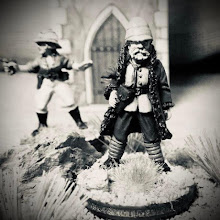
This was a fun little vignette to make. I had some extra figures from Phase 1 (Wargames Foundry purchase); one of which was a general or senior official of the Qing dynasty. In addition I used my small hobby drill to make a hole in an extra artilleryman carrying ammunition and also had an extra infantryman to represent the general's body guard.


The above is the figure before I decided to make a "higher" command base for my Qing forces. Higher commands are not used in The Men Who Would be Kings but I know many people have house rules to include them in larger games. Senior officials would have various animals in the cloth patches depending on their rank; there was no way I was going to attempt that so I just painted what I thought would look good at gaming distance.

I found this image of Nieh Shih-ch'eng by an unattributed artist after I painted the figure. I'm going to look for a figure like this because it just looks cool.


Here is the artilleryman who is now a standard bearer. Don't look toooooo closely at his hands! Before I mounted the figure on the base I touched up the flag and a few places on his uniform. The flag is from North Star Military Figures on the Crusader Miniatures site under the Boxer Rebellion.


The base is from Litko and I used a hobby knife to line out the cobblestones and various greys and shades on the cobblestones. Add some hobby sand, figures, static grass and lichen and it doesn't look to bad.


I forgot to mention that the gong is from Pulp Figures.


Next: The Artillery.

Monday, September 1, 2025

The Boxer Rebellion Project, Part 12: First Imperial Chinese Infantry Unit

Figures from Wargames Foundry.

HUZZAH! I have finished my first Infantry Unit for The Men Who Would be Kings (TMWWBK). As previously mentioned I'm basing my Imperial Chinese Field Force on the Imperial forces that faced the Second Relief Expedition led by General Sir Alfred Gaselee, GCB, GCIE.

Imperial Army lieuntenant with the Qing Dynasty Banner. Banner can be purchased from North Star Military Figures.


The recommend size for Regular and Irregular Infantry units in TMWWBK is 12 figures. I decided that the first unit would look more "traditional" with primarily the classic Manchu hat and uniforms.

Another banner bearer, the commanding officer and a drummer (duh!).

Uniforms are a bit more fancier than what I am used to painting and take more time - but it is well worth the effort.


They are ready to repel enemies internal and external.


Thursday, August 28, 2025

The Boxer Rebellion Project, Part 11: Deciding on Uniform Colors for The Resolute Army

Figures from Wargames Foundry.

 In my post when I outlined my "generic" Imperial Chinese Army for The Men Who Would be Kings, I outlined that I was going to use as my template Chinese Imperial forces that faced the Second Relief Expedition under General Sir Alfred Gaselee, GCB, GCIE. For purposes of my organization of units, I'm referring to my first 2 Infantry units and my artillery gun as belonging to the Resolute Army. An Army in the Chinese Imperial Army at this time could be anything from a regiment sized force up to a Brigade/Division. As is my usual practice when painting units or armies I am not familiar, I decided to do a few test figures to figure out how I wanted the units to look.

First up will be the commander of an Infantry unit that will have more of a traditional Chinese look instead of the more Westernized units. The figure is from Wargames Foundry and is from one of the command packs from their Taiping Rebellion in China 1851-66 range. Most of the range is suitable for the Boxer Rebellion and fits in nicely with other ranges. The above officer is from Pack CH001 Chinese Command.


Military mandarins or officers wore a silk jacket in in various colors and senior officers wore predominantly purple. In addition on the front and sometimes the back, highly decorative embroidered cloth panels would be part of the jacket. In this scale, all you are getting from me is some "Chinese" lettering! Headgear was a Manchu hat often replaced with a bamboo sun hat in the summer with red tassels attached at the top.

Ready to fight enemies of the Qing Dynasty - both external and internal (though I think I need to add just a little shading to the face).

The next unit.

Next up will be my first Infantry unit which will be wearing traditional Chinese "uniforms" and once again is from Wargames Foundry Pack CH004 Chinese Musketeers. Even though they are carrying matchlocks, I'm going to pretend that they have a mixture of muskets with obsolete and modern breechloaders. The unit will be based on the above print. I forgot to mention that all of the figures were painted with a combination of Vallejo and Citadel Contrast paints.


Chinese Imperial soldiers always wore brightly colored uniforms which is one of the appeals of this period. The main garment was a loose fitting tunic of silk, cotton or linen usually bordered with a contrasting color. The tunic was issued by the unit commander but anything else worn under it was usually provided by the soldier themselves. Many troops wore a sleeveless surcoat (as above). Some "elite" units were more standardized than the other units depending on the money spent by the commander. On the chest and back of the tunic was a cloth disc, usually in white or yellow, which bore characters displaying the soldier's unit and commander and sometimes even position.


Typical headgear would be a turban worn in various styles or the classic Manchu hat. The black Manchu hat with a turned up brim and red crown were made from various materials depending on rank.


Infantry unit number 2 will wear a more Western cut of uniform though it retains aspects of a  traditional Chinese look. With uniform colors you really can't go wrong; most units wore dark blue or various shades of blue. Contemporary Western observers (when I use the term "Western Observers" I am also including the Japanese), prints (both Chinese and Western) show colors of white, yellow, green, brown, red and dark red. You can't go wrong.


The above figure is Pack CH023 Ever Victorious Army Infantry. As mentioned earlier, most troops wore various types of turbans in dark blue, blue, black and red worn by regulars. Some of the Yung units (another post in of itself) wore turbans of yellow, scarlet and dark blue. My figure's uniform is a westernized cut of a double breasted silk tunic and decorative embroidered red panels.


Yep. I need to add some shading to his face too.

Since artillery crews are only 4 figures in TMWWBKs, I decided to knock out 3 figures and I'm going to add a 4th officer figure later.


This is another "Western" style looking unit in blue with red turbans and the traditional discs. Various pictures of the time show that even within the same unit, the discs may not be of a uniform design or attached in the same place. The Wargames Foundry pack is CH024 Ever Victorious Army Artillery Crew.


Don" bother looking up the Chinese characters; I made them up based on photographs and illustrations of the time and painted what I thought would look good at gaming distance.

Now it's time to get the painting assembly line going.


Wednesday, August 27, 2025

WizKids Deep Cuts Unpainted Miniatures: Wave 7: Pack Mule

The The 1st Madras Pioneers with supplies on the Northwest Frontier.

 Most gamers hate logistics in a game; but, the reality is that logistics are an important (ESSENTIAL!) part of warfare. As an exercise, I use to have my cadets calculate how much water is needed for an average US Army Mechanized Infantry battalion - and water is heavy. If I use logistics in a game, I like simplified rules such as knowing how many shots I have before running out of ammunition or a random roll. Having said that, you can have fun with logistics through escort missions of just having nice scatter pieces to be on the table. Having said that, these ridiculously overloaded mules from WizKids Deep Cuts Unpainted Miniatures are inexpensive and a quick way to get the logistics train rolling.

Bombay Sappers and Miners in China, 1900.

The mules come 2 to a pack, are semi-hard pre-primed resin. Essentially I just used GW Citadel Contrast paints to knock them out in about 2 days.


Not bad for (except the drunk mule that I need to straighten out) for approximately $11 USD.


Thursday, August 7, 2025

The Boxer Rebellion Project, Part 10: Generic 8 Nations Field Forces of General Gaselee's Relief Force


For my first 8 Nations Alliance Field Force to use with The Men Who Would be Kings, I'm focusing on General Sir Alfred Gaselee, GCB, GCIE, second relief expedition. Why? All of the 8 Nations Alliance forces provide variety and color, but I choose this because I already had some figures for the force though I painted some more to add the color and historical makeup of the Alliance.


In the summer of 1900, when the Boxer Uprising in China was at its height, Gaselee was chosen to command the British element in the international expeditionary force, and on 3 July 1900 promoted to major-general. Gaselee was nominally put in charge of the Second Expedition because the Eight-Nation Alliance refused to the allow the Japanese general Yamaguchi Motomi to lead it, even though he was the highest-ranking officer present. As a reward for his services, he was created Knight Grand Commander of the Order of the Indian Empire (GCIE) on 24 July 1901.

Here are some of my "generic Field Forces" I'm going to use first with a 24 point limit: 


1. Japanese Infantry Unit.
    Regular Infantry: 6 points.
    
    Total: 6 points.

The Japanese had the largest contribution to the 8 Nations Alliance; plus the new Crusader Miniatures look cool.


2. Indian Infantry Unit.
    Regular Infantry: 6 points.

    Total: 6 points.

The British were strapped for manpower with the Boer War. Most of the British troops came from India including the 1st Indian Brigade which consisted of the 1st Sikh Infantry Punjab Frontier Force, 24th Punjab Infantry, and the 7th Rajput Infantry. 


3. Austrian-Hungarian Naval Brigade.
    Regular Infantry: 6 points.

    Total: 6 points.

Come on! You knew von Trapp and company would be included!

Gun and crew from Tsuba Miniatures.

4. Russian Artillery.
    Well Drilled Crew: 6 points.

    Total: 6 points.

The above is actually an Imperial Russian Putilov M1902 76mm quick firing gun which was first used in the Russo-Japanese War in 1905. Close enough for now until I get an older gun.

Total points: 24.

Or . . . 

1. Japanese Infantry Unit.
    Regular Infantry: 6 points.
    
    Total: 6 points.

Figures from Copplestone Castings.

2. Russian Infantry Unit.
    Regular Infantry: 6 points.
    Poor Shots: -1 point. Russian firing doctrine emphasized volley fire and not individual marksmanship.
    Unenthusiastic: -1 point. Infantry were conscripts from the East Siberian Regiment and were not quite up to Western (and Japanese) standards.

    Total: 4 points.

The above is my version of the The Izmaylovsky Lifeguards Regiment circa 1905. Evantually I will get some earlier Russian infantry for the Boxer Rebellion.

3. Austrian-Hungarian Naval Brigade.
    Regular Infantry: 6 points.

    Total: 6 points.


4. 1st Bengal Lancers.
    Regular Cavalry: 6 points.
    Lancers: +2 points.

Total: 8 points.

The 8 Nations Alliance did not have a lot of cavalry and the 1st Bengal Lancers did yeoman service. The above are Perry Miniatures painted as the The 10th (The Duke of Cambridge's) Bengal Lancers (Hodson's Horse) and they will do the trick.

Total points: 24.

So far that's what I'm doing though eventually I will have some troops for Admiral Seymour's relief attempt, the follow-up expeditions after Peking was captured, and the Legation defense.