

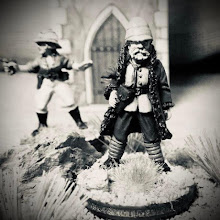
LTC Webster (local rank Brigadier General) scouting the terrain at Beatty's Ford in North Carolina in the pursuit of Brigadier General Daniel Morgan.
Born in 1743 to an Edinburgh minister, James Webster entered the 33rd Regiment of Foot as a Lieutenant on May 10, 1760, steadily rising through the ranks to become lieutenant colonel under Cornwallis. He took command of the regiment when Cornwallis received a promotion to lieutenant general in January 1776 and, the following month, Webster and his regiment left England, bound for service in North America.

LTC Webster consults with Lord Cornwallis during the Southern Campaign.

Webster and the 33rd Foot. Webster wears the uniform of a senior officer with the red facings of the 33rd Regiment.
As the British entered the interior of South Carolina, the 23rd Regiment of Foot (Royal Fusiliers) joined Webster to form a demi-brigade. Webster's regiments formed Cornwallis's right at the Battle of Camden on August 16. Facing inexperienced Virginia militia, Webster smashed through the Patriot line, wheeling his men into position to further engage Continentals under Maj. Gen. Johan de Kalb. This maneuver contributed to the disintegration of the Patriot force still on the field and led to a British victory. From then on, Webster commanded Webster's Brigade consisting of the 23rd Foot and the 33rd Foot.


Webster leads his brigade toward Guilford Courthouse, North Carolina.
At some time during the battle, Webster sustained an injury to his leg, to which he succumbed weeks later. Devastated by the loss, Cornwallis penned a letter to Webster's father. "It gives me great concern to undertake a task which is not only a bitter renewal of my own grief but a violent shock to an affectionate parent," the general wrote. "Your son fell nobly in the cause of his country, honored and lamented by all his fellow soldiers; that he led a life of honor and virtue, which must secure him everlasting happiness."
The figure I painted as Webster will be one of my brigade commanders and it is no coincidence that it will lead the 23rd Regiment and 33rd Regiment as a representation of Webster's Brigade in the Southern Campaign. The figure is from the British Brigade box and I wanted to have a commander that was not in the usual blue facing colors of a British general officer thus the facings of the 33rd Regiment.


No comments:
Post a Comment