As an Amazon Associate I earn from qualifying purchases

Showing posts with label Litko Game Accessories. Show all posts

Monday, September 8, 2025

The Boxer Rebellion Project, Part 13: Captain General Nieh Shih-ch'eng of the Tenacious Army

聂士成

Nieh Shih-ch'eng (Wade-Giles version of name; see, I've been researching!) was a Chinese general of the Qing dynasty who served the imperial government during the Boxer Rebellion. Rising from obscure origins from Hefei, Anhui Province, in the early 1850s, Nieh Shih-ch'eng managed to pass the county examinations for bureaucratic positions, but due to the Taiping rebellion he was forced to abandon a bureaucratic career and become a soldier. Oh no! Forced to abandon bureaucratic misery (and graft) and be an honorable man and soldier!


In the late 1850s, Nie was in the service of Yuan Jiasan (the father of Yuan Shikai) against rebel forces in the Nian Rebellion, under whom he was commissioned as a lieutenant and then in the Huai Army in the suppression of the Taiping Rebellion, at the end of which he was promoted to general. He went on to serve Sino-French War of 1885, the suppression of minor revolts against the Qing dynasty, First Sino-Japanese War, and the Boxer Rebellion.

Throughout his career, Nieh Shih-ch'eng attempted to reform Chinese military forces to be more effective and along Western lines. Following China's loss in the First Sino-Japanese War, Nieh Shih-ch'eng was able to restructure his army and it renamed as the Wuwei Front Division. Trained by Russian military advisers and equipped with German and Russian weaponry, it was considered the most modern of the Qing armies of the time.

Nieh was not an active participant in the political intrigues of the Qing court, but was considered politically conservative and supported Empress Dowager Cixi against the Hundred Days' Reform. In his suppression of the Boxer Rebellion, Nie was in an ambiguous position. On one hand, as a general in the Qing army, he pursued a vigorous offensive against rebel guerilla forces in early 1900. Condemned by the pro-Boxer faction of the imperial court, Nie achieved impressive success inflicting large numbers of casualties during the year.

On the other hand, he could not accept the invasion of China by the Eight-Nation Alliance so he fought against the Alliance forces. Because Nie's forces killed so many Boxers, it was Dong Fuxiang's Kansu Braves who instead allied with the Boxers to oppose the Seymour Expedition, a multinational force of over 2,000 men, in its march to Beijing.

On 9 July 1900, while personally leading a counterattack against Russian forces under the command of General Anatoly Stessel in the Battle of Tientsin, Nie was fatally wounded when an artillery shell exploded nearby.

Japanese soldiers attacking during Battle of Tientsin.

In the Nankai District of Tianjin in present-day China, a "Nie Shicheng Martyrs Monument" is located in the area, to General Nie Shichen who died in battle in the Boxer Rebellion at the Battle of Tientsin.

Nie Shicheng Martyr's Monument.

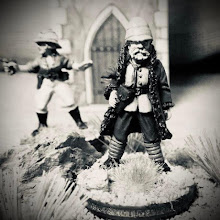
This was a fun little vignette to make. I had some extra figures from Phase 1 (Wargames Foundry purchase); one of which was a general or senior official of the Qing dynasty. In addition I used my small hobby drill to make a hole in an extra artilleryman carrying ammunition and also had an extra infantryman to represent the general's body guard.


The above is the figure before I decided to make a "higher" command base for my Qing forces. Higher commands are not used in The Men Who Would be Kings but I know many people have house rules to include them in larger games. Senior officials would have various animals in the cloth patches depending on their rank; there was no way I was going to attempt that so I just painted what I thought would look good at gaming distance.

I found this image of Nieh Shih-ch'eng by an unattributed artist after I painted the figure. I'm going to look for a figure like this because it just looks cool.


Here is the artilleryman who is now a standard bearer. Don't look toooooo closely at his hands! Before I mounted the figure on the base I touched up the flag and a few places on his uniform. The flag is from North Star Military Figures on the Crusader Miniatures site under the Boxer Rebellion.


The base is from Litko and I used a hobby knife to line out the cobblestones and various greys and shades on the cobblestones. Add some hobby sand, figures, static grass and lichen and it doesn't look to bad.


I forgot to mention that the gong is from Pulp Figures.


Next: The Artillery.

Monday, April 21, 2025

Operation Heinlein: Strike Force Commander


"As a Space Marine officer, I prefer not to wear my helmet into combat. Heads up displays, thermal imagery, communication nets, real time location and the status of my Marines - plus the protection it provides are for sissies. Plus I can see my chain sword better without it.


As a follow-up to my earlier post on painting armored infantry, unh Space Marines copyright by Games Workshop with blood oaths, Dwarven runes and Chaos Demon lawyers, I finally found the commander for my Armored Infantry Strike Force commander for Xenos Rampant.


I was able to get the Boardgame “Space Marines” which is sold exclusively at Target or online from GW for the ridiculously low price of $25 US dollars. It’s actually a fun, fast game and comes with Lieutenant Titus of the Ultramarines and 10 Tyranid termagants and 3 ripper swarms. It pays to wait for sales.


Lieutenant Titus will get a new name for Xenos Rampant. I did the figure just using Citadel Contrast (CC) paints and as always use a quality primer! In this case I use Citadel Bone Wraith. There is a little paint on his face because I wanted to get a picture of the primed figure and almost forgot.


For the skin I used a base of Vallejo Dark Flesh and then added a wash of CC Darkoath Flesh for shading and detailing. 


The chain sword (let’s face it, chain swords are ridiculous but cool) is painted with CC Black Templar.


It’s time for CC Ultramarine Blue for the armor. I’m not worried about a smooth, even application as I want the armor to look like it’s been used in combat and not on the parade field.


The star burst is CC Blood Angel Red and I later cleaned it up with Vallejo Flat Red. 

The blue hanging rectory weird GW bone box I’m going to pretend it is a medical kit. I painted it with CC Aethermatic Blue and all of the leather is painted with CC Snakebite Leather.


The scroll under the skull is Striking Scorpion Green, the battle honor strips are CC Skeleton Horde with the seals CC Blood Angel Red. The skull on the base is also CC Skeleton Horde and the STUPID loin cloth, one more thing to get stuck in combat, is CC Nazdreg Yellow. The hilt on the chain sword is Vallejo Shiny Gold.


The wreath is also CC Striking Scorpion Green.


The concrete is CC Space Wolves Grey and the pipe will be eventually painted with CC Basilicum Grey.


I forgot to mention that the weapon and other bare metal is CC Basilicum Grey.

I used my usual basing mix of various sizes of railroad hobby ballast. I painted the base color Vallejo Luftwaffe Uniform WWII and dry brushed Vallejo Neutral Grey followed by Vallejo Light Grey.


The side of the base is Vallejo Flat Brown.


Always keep those bits. Since the leader has a larger base, I added a Necron arm to give it a little jazz.


Regular ole green static grass from Gale Force 9.


Ta Dah!


Friday, April 18, 2025

Lt. Col. Shiba Gorō


Whoops. I forgot to paint his mustache. A great figure of a Japanese officer from Crusader Miniatures.

Shiba Gorō (柴 五郎, June 21, 1860 – December 13, 1945) was a samurai of Aizu Domain and later a career officer and general in the Meiji period Imperial Japanese Army. Shiba Gorō witnessed the events of the Boshin War as a child when Aizu was attacked by the imperial forces in 1868. With the abolition of the Han system, he moved to Tokyo and enlisted in the fledgling Imperial Japanese Army in 1873. He was in the 1877 class of the Imperial Japanese Army Academy and was commissioned as a second lieutenant in the artillery in 1879.


I’m not going to cover this remarkable warrior's entire career but focus on the Boxer Rebellion and the Russian Japanese War. In March 1900, Shiba returned to Beijing as a military attaché, and was thus present at the Japanese legation during the Boxer Rebellion. There his small force fought tenaciously and suffered almost 100% casualties over a 60 day period. He served with distinction during that campaign, aided by his prior knowledge of Beijing and by a large network of local spies. He protected the citizens and diplomats alongside several Western powers during the siege, and was subsequently awarded decorations by many of the western nations in the Eight-Nation Alliance. Shiba's role in the Boxer Rebellion is often highlighted in Western accounts of the conflict. In the 1963 film 55 Days at Peking about the siege of international legations he is a supporting character, played by future director Juzo Itami.


In March 1901, he was returned to Japan and attached to the General Staff. In June 1901 Shiba was appointed commander of the IJA 15th Field Artillery Regiment, which he continued to command after the start of the Russo-Japanese War in 1904, where he was awarded the Order of the Golden Kite (2nd class), for bravery in battle.

Here is my painting guide for Lieutenant Colonel Shiba Gorō which, with minor changes, will be used for my other Japanese Infantry.


For 28mm figures I like to glue them to soda caps with all purpose white glue for easy handling. Wait for the glue to dry! I first painted the flesh CC Darkoath Flesh and I was quite pleased with the results.


When I’m trying to work out which paint colors to use on a new unit/army I rarely use an officer figure; but this Crusader Miniature looked so cool I had to give it a try. My gut feel for the uniform was to use a base of Vallejo Prussian Blue and then to highlight with Vallejo Dark Blue. And then I said to myself, “Self, let’s try a heavy coat of Citadel Contrast (CC) Ultramarine Blue. When using contrast/speed paints it’s important to use a quality primer (trust me on this one!). I used Citadel Wraithbone.


He wears the dark blue Atilla blouse and the black braid (it’s hard to see in this picture), boots and cap brim are CC Black Templar. I initially used CC Blood Angels Red but I realized I would need to use Vallejo Flat Red with a detail brush to simulate the finer, well, details. Oh by the way, there was no way I was going to try painting the Austrian loops on the sleeve. The red (technically scarlet) indicates a member of the Imperial Guard.


After doing more research, I realized that I made the trouser stripe too narrow. As a field grade office it should be about twice as wide. I’ll fix that later.


It was also at this time (nothing like carefully checking before you paint!) that he should also have 2 rings on his cap as a Lieutenant Colonel and two stars on the front of the cap. All leather is also CC Templar Black.


As mentioned earlier, I used Vallejo Flat Red to clean up the cap and Vallejo Shiny Gold for the stars. He carries the M1888 officers sword and I used Vallejo Shiny Gold for the details and Vallejo Silver for the scabbard.

I used Vallejo Flat White to make the trouser stripe wider and used CC Blood Angels Red for the stripe. The figure is glued to a 25mm Litko wood base and I used my normal sand mixture and static grass to finish the base. Don’t forget to protect the figure with a clear matte spray.