As an Amazon Associate I earn from qualifying purchases

Showing posts with label Military History. Show all posts

Monday, August 4, 2025

The Boxer Rebellion Project, Part 9: 1st Sikh Regiment, Punjab Frontier Force

The former 1st Sikhs, Punjab Frontier Force in 1905. They were redesignated the 51st Sikhs (Frontier Force) in 1903. Note the different ethnic groups by turban; the name of a regiment was the recruiting area (usually) and did not designate the ethnicity of the unit. Ethnicity was usually by company to facilitate logistically the food rations.

I received a three way bonus with this unit! 

1. They fought in the Northwest Frontier Uprisings of 1897 to 1898 - a conflict I already game.
2. They fought in the Boxer Rebellion.
3. The unit has a piper (HUZZAH!).

1st Sikhs, Punjab Frontier Force. Figures by Perry Miniatures.

I'll be the first to admit, this unit (except for the piper) was a rush job. I painted them quickly so I could move onto the Chinese Imperial Army figures I recently purchased from Wargames Foundry. In reviewing the pictures, and as I was painting, I realized that I would need to go back a few touch ups and highlighting to bring them up to my (ahem) gaming distance standards. I love the size of 12 figure Regular Infantry for The Men Who Would be Kings; the game rules I pretty much use exclusively for my Colonial gaming.

British and Sikh officer.


The regiment was raised on 10 December 1846 at Hoshiarpur as the 1st Regiment of Infantry, The Frontier Brigade by Major JS Hodgson. It was composed of Sikhs, Punjabi Muslims, Pathans and Dogras, mostly recruited from the disbanded regiments of the Sikh Empire following the First Anglo-Sikh War. In 1847, it was designated 1st Regiment of Sikh Local Infantry, becoming the 1st Regiment of Sikh Infantry in 1857. 

Havildars (Sergeants) to steady the line.

I need to repaint the chevrons.

In 1851, the regiment became part of the Punjab Irregular Force, which later became famous as the Punjab Frontier Force (PFF) or The Piffers. The Piffers consisted of five regiments of cavalry, eleven regiments of infantry and five batteries of artillery besides the Corps of Guides. Their mission was to maintain order on the Punjab Frontier; a task they performed with great aplomb. The 1st Sikh Infantry took part in numerous frontier operations besides the Second Sikh War of 1848–49 and the Great Indian Mutiny of 1857–58, when it fought in Rohilkhand and Oudh in North India. During the Second Afghan War of 1878–80, the regiment took part in the capture of Ali Masjid and the advance to Jalalabad. It also performed operations during the NW Frontier uprising in 1897-1898. In 1900, it went to China to suppress the Boxer Rebellion.

Piper Khan.

The British (you know I mean the Scottish Regiments!) used bagpipes in their army bands and  introduced the instrument to India in the 19th century. The Indian military style of bagpipe-playing, which is sonorous and set to Scottish tunes, draws directly from this tradition.

"Frontier Force". Left to right: 59th Scinde Rifles, Piper of 51st Sikhs (1st Sikhs of our period) and 56th Punjabi Rifles. Watercolour by Major AC Lovett, 1910. Even though the bagpipe illustrated is green, I decided to give mine a tartan pattern.

Bugler. Yep, I need to clean up the figures a bit.

When the Boxer Rebellion broke out in 1900, the British, as part of the 8 Nations Alliance, was hard pressed to provide troops as it was heavily committed to the Boer War in South Africa. As a result, the overwhelming majority of troops came from the Indian Army, including the 1st Sikhs, PFF. On the tabletop, the Khaki uniforms will look great alongside the blue of Japan, the white of sailors, US Marines and US Army, etc.

Sepoys.

"Looking a bit sloppy Major!"

The above officer figure will be perfect for The Men Who Would be Kings. Leadership and Leadership Traits are rolled for each officer and if the Leadership Traits "Drunkard" or "The gentleman has a bottle" is rolled, this will be the officer figure used as a reminder. Believe it or not, he is holding a canteen which definitely needs to be repainted! Not only that, I forgot to paint his mustache. Quite.


Thursday, June 5, 2025

The Boxer Rebellion Project, Part Two: The SMS Zenta

The SMS Zenta in 1901 at the Pola Shipyard after returning from China in 1901.

Truth in advertising time: I'm an Infantry, maneuver warrior kind of guy. But I love old ships. My real world experience with the United States Navy was interesting. At one time (this sounds more impressive than what it really is) I was the Lead Joint Planner, Deputy Chief of Staff for Operations, United States Army Europe. I got to work in a vault in Heidelberg, Germany. On the gripping hand, I got to work with the Navy and Air Force and could chose which operations I would be involved with - as long as the 2 Star was okay with it! As the Lead Planner, I was also the Army Liaison to the US Sixth Fleet. I actually had a billet, when activated, on the now decommissioned USS LaSalle.

The Navy loved me when I was on board when I was on that great boat, umm, ship the USS Lasalle:

"Excuse me Chief, what floor is Commander Smith on?'
"It's a deck sir."

"Do I go through this door Chief?'
"It's a bulkhead sir."

"Excuse me Chief, is the latrine through that door, er, bulkhead?
"You mean the head sir?'

"Now where did I put my hat?"
"Here's your cover, sir."

"During General Quarters, should I be on the left side of the ship, or the right side of the ship?"
"I don't care what the admiral said, I'm putting you in the brig sir."

They loved me! Gaming with ships can be fun too! Just don't have me in command of your flotilla. Let's see, how many times did I get my gunboats stuck on sandbars going up the Nile River in the 1890's? My greatest success was storming a British gunboat that got stuck during a fictional Boxer Rebellion game as an Imperial Chinese commander during a great game of The Sword and the Flame, Those were the days.

Anyway, while recovering from foot surgery, I discovered the Georg von Trapp of Sound of Music fame was a decorated hero during the Boxer Rebellion which is my next project. Here are some details on his ship, the armored cruiser SMS Zenta just for fun.


The SMS Zenta was launched in 1897 and represented one of the new iron ships in the Austro Hungarian fleet, a transition away from wooden vessels. Her overall length was 96.88 meters (317 ft 10 in) and a beam of 11.73 meters (38 ft 6 in). Her two four-cylinder vertical triple-expansion steam engines, each drove a single propeller shaft with eight Yarrow boilers for an average total of 8,160 indicated horsepower (6,080 kW),  achieving a maximum speed of 21.87 knots (40.50 km/h; 25.17 mph).


She also had the extra protection of an armor deck, two layers of 12.5 millimeter (0.49 in) plates and 50 millimeters (2.0 in) over the engine and boiler rooms. Further, she was armed with two 45 centimeter (17.7 in) torpedo tubes, eight 40-caliber Škoda 12 centimeter (4.7 in) quick-firing guns, eight 44-caliber 4.7 centimeter (1.9 in) Škoda guns, and two 33-caliber 4.7 centimeter Hotchkiss guns.

The start of my Austro-Hungarian landing party; figures are Russian Navy from Copplestone Castings Back of Beyond range.

Next: Lt. Col. Shiba Gorō of the Japanese Imperial Guard.

Monday, June 2, 2025

The Boxer Rebellion Project, Part One: Midshipman Second Class Georg von Trapp


Yes. That von Trapp. As we all know from The Sound of Music, etc., Georg Ludwig Ritter von Trapp was an officer in the Austro-Hungarian Navy who became the patriarch of the Trapp Family Singers. Captain von Trapp Trapp was the most successful Austro-Hungarian submarine commander of World War I, sinking 11 Allied merchant ships totaling 47,653 GRT and two Allied warships displacing 12,641 tons. 


Hmmm . . . I think I gave him Groucho Marx eyebrows. that will be an easy fix.

But how many of us knew that he participated, and was awarded for bravery during the Boxer Rebellion? Ladies and Gentlemen, the SMS Zenta:

In 1894, aged fourteen, Trapp followed in his father's footsteps and joined the Austro-Hungarian Navy, entering the Imperial and Royal Naval Academy at Fiume (today Rijeka, Croatia). In 1900, as a midshipman, he was assigned to the protected cruiser SMS Zenta and was decorated for his performance during the Boxer Rebellion in China, in which he participated in the assault on the Taku Forts. He personally led the Austro-Hungarian sailors that helped assault and capture Fort Pei Tang. For his bravery he was awarded the Silver Bravery Medal, 2nd Class and the War Medal.

Silver Bravery Medal, 2nd Class 

War Medal

In doing my research I noticed that many European Navies had similar uniforms and that the differences in 28mm are not noticeable. Now if you want to do the French, you can buy the figures with the pom pom on the top or even use British navy figures with Sennet hats as photographic evidence from the Boxer rebellion has them wearing (outside of Legation forces). Back back to the Austrians. I thought the Copplestone Castings Russian Sailors from their Back of Beyond range would be perfect for the Austrian Sailors from the SMS Zenta (reinforced later by the SMS Kaiserin und Königin Maria Theresia, SMS Kaiserin Elisabeth, SMS Aspern and an additional 160 Austrian marines).

"The Capture of the Forts at Taku", by Fritz Neumann in the Anne S.K. Brown Military Collection, Brown University.
I accidentally painted the figure as a Koverttenleutnant thinking that he already passed his Lieutenant examination and had been commissioned at this time - and by golly, the figure is going to stay that way!


Tuesday, December 10, 2024

Lieutenant Charles Deschamps de Boishébert et de Raffetot, Compagnies Franches de la Marine

  Lieutenant Charles Deschamps de Boishébert et de Raffetot, Compagnies Franches de la Marine.

 Charles Deschamps de Boishébert et de Raffetot was born in Quebec on February 7th, 1727 and entered upon a military career early in life. He became a gentlemen cadet in the Campagnies Franches de la Marine in 1739, with the comment “a promising young man, very steady.” In 1742 he joined the Quebec garrison as assistant adjutant. During the years 1744 and 1745 he participated in several expeditions along the New York frontier.

 After the first Siege of Louisbourg in May–June 1745, a British force composed largely of New England irregulars proceeded to seize Île Saint-Jean (present day Prince Edward Island) and its capital Port-la-Joye, which had a French garrison consisting of about 15 soldiers and 100 Mi'kmaq. The British force consisted of two Royal Navy ships and 200 New England soldiers stationed at Port-La-Joie. Boishébert was sent to Île Saint-Jean on a reconnaissance to assess the size of the British force. After Boishébert returned, the French Army with over 500 men, 200 of whom were Mi'kmaq, went to Port-la-Joye. The battle took place in July 1746 near Port-la-Joye on the bank of the Northeast River and the French killed forty New Englanders and captured the rest.  Boishébert was commended for having distinguished himself during the battle exposing himself to danger and personally leading attacks against the enemy force.

 On 28 Feb. 1748 Boishébert was promoted lieutenant, and he soon was engaged in operations in yet another part of New France. The previous year had seen the threat of a general Indian uprising in the west, and in the spring of 1748 Boishébert was among the reinforcements sent under Pierre-Joseph Céloron de Blainville to Detroit, which was particularly endangered. He took part in an expedition that took revenge on the Indians for attacks that had been made on the French in the vicinity.

At the beginning of the French and Indian War, he was sent to take command of Fort La Tour, at the mouth of the Saint John River, and there he worked to counter persistent British efforts to establish themselves. He also made a study of the harbours between Acadia and Boston. The capture of Fort Beauséjour (near Sackville, N.B.) on 16 June 1755 by British Lieutenant Colonel Robert Monckton’s forces marked a turning-point in Boishébert’s career. Immediately after the fort fell, the British commander dispatched a large detachment against the handful of militiamen at Fort La Tour. As there was no hope of a successful outcome, Boishébert burned his fort before the enemy arrived and sought refuge among the local populace, continuing meanwhile to fight the enemy. The rest of his career in Acadia was spent working to secure the Acadians’ loyalty to France, bringing to French territory as many of those in British-occupied regions as possible, and with the Indians’ help constantly skirmishing against the enemy.  


Charles Deschamps de Boishébert et de Raffetot was a real officer of the Compagnies Franches de la Marine and he is going to be the Officer for the French Forces in Rebels and Patriots (Paid Link). When I rolled for the Officer Traits for the French Officer, I knew I had to find a man worthy of the roll. From my research, he was an outstanding leader, tactician, and compassionate man. I rolled a "3" and then a "4" giving him the trait "Strategist". This allows him to redeploy 6 points of troops (which is exactly the point count of a normal unit of Compagnies Franches de la Marine) up to 12 inches away from their original deployment point but no closer than 12 inches to an enemy unit. Yikes! The British are going to have their hands full with this guy.

 
The figure of the Officer of Compagnies Franches de la Marine is from North Star miniatures. As you have probably noticed, I forgot to paint his eyes.

Victoire sur les intrus britanniques!

Monday, July 3, 2023

Independence Day: The Original Brexit


IN CONGRESS, July 4, 1776.
The unanimous Declaration of the thirteen united States of America,
When in the Course of human events, it becomes necessary for one people to dissolve the political bands which have connected them with another, and to assume among the powers of the earth, the separate and equal station to which the Laws of Nature and of Nature's God entitle them, a decent respect to the opinions of mankind requires that they should declare the causes which impel them to the separation.


We hold these truths to be self-evident, that all men are created equal, that they are endowed by their Creator with certain unalienable Rights, that among these are Life, Liberty and the pursuit of Happiness.--That to secure these rights, Governments are instituted among Men, deriving their just powers from the consent of the governed, --That whenever any Form of Government becomes destructive of these ends, it is the Right of the People to alter or to abolish it, and to institute new Government, laying its foundation on such principles and organizing its powers in such form, as to them shall seem most likely to effect their Safety and Happiness.


Prudence, indeed, will dictate that Governments long established should not be changed for light and transient causes; and accordingly all experience hath shewn, that mankind are more disposed to suffer, while evils are sufferable, than to right themselves by abolishing the forms to which they are accustomed. But when a long train of abuses and usurpations, pursuing invariably the same Object evinces a design to reduce them under absolute Despotism, it is their right, it is their duty, to throw off such Government, and to provide new Guards for their future security.--Such has been the patient sufferance of these Colonies; and such is now the necessity which constrains them to alter their former Systems of Government. The history of the present King of Great Britain is a history of repeated injuries and usurpations, all having in direct object the establishment of an absolute Tyranny over these States. To prove this, let Facts be submitted to a candid world.


He has refused his Assent to Laws, the most wholesome and necessary for the public good.
He has forbidden his Governors to pass Laws of immediate and pressing importance, unless suspended in their operation till his Assent should be obtained; and when so suspended, he has utterly neglected to attend to them.
He has refused to pass other Laws for the accommodation of large districts of people, unless those people would relinquish the right of Representation in the Legislature, a right inestimable to them and formidable to tyrants only.
He has called together legislative bodies at places unusual, uncomfortable, and distant from the depository of their public Records, for the sole purpose of fatiguing them into compliance with his measures.


He has dissolved Representative Houses repeatedly, for opposing with manly firmness his invasions on the rights of the people.
He has refused for a long time, after such dissolutions, to cause others to be elected; whereby the Legislative powers, incapable of Annihilation, have returned to the People at large for their exercise; the State remaining in the mean time exposed to all the dangers of invasion from without, and convulsions within.
He has endeavoured to prevent the population of these States; for that purpose obstructing the Laws for Naturalization of Foreigners; refusing to pass others to encourage their migrations hither, and raising the conditions of new Appropriations of Lands.


He has obstructed the Administration of Justice, by refusing his Assent to Laws for establishing Judiciary powers.
He has made Judges dependent on his Will alone, for the tenure of their offices, and the amount and payment of their salaries.
He has erected a multitude of New Offices, and sent hither swarms of Officers to harass our people, and eat out their substance.
He has kept among us, in times of peace, Standing Armies without the Consent of our legislatures.
He has affected to render the Military independent of and superior to the Civil power.
He has combined with others to subject us to a jurisdiction foreign to our constitution, and unacknowledged by our laws; giving his Assent to their Acts of pretended Legislation:

For Quartering large bodies of armed troops among us:
For protecting them, by a mock Trial, from punishment for any Murders which they should commit on the Inhabitants of these States:
For cutting off our Trade with all parts of the world:
For imposing Taxes on us without our Consent:
For depriving us in many cases, of the benefits of Trial by Jury:
For transporting us beyond Seas to be tried for pretended offences
For abolishing the free System of English Laws in a neighbouring Province, establishing therein an Arbitrary government, and enlarging its Boundaries so as to render it at once an example and fit instrument for introducing the same absolute rule into these Colonies:

For taking away our Charters, abolishing our most valuable Laws, and altering fundamentally the Forms of our Governments:
For suspending our own Legislatures, and declaring themselves invested with power to legislate for us in all cases whatsoever.
He has abdicated Government here, by declaring us out of his Protection and waging War against us.
He has plundered our seas, ravaged our Coasts, burnt our towns, and destroyed the lives of our people.
He is at this time transporting large Armies of foreign Mercenaries to compleat the works of death, desolation and tyranny, already begun with circumstances of Cruelty & perfidy scarcely paralleled in the most barbarous ages, and totally unworthy the Head of a civilized nation.
He has constrained our fellow Citizens taken Captive on the high Seas to bear Arms against their Country, to become the executioners of their friends and Brethren, or to fall themselves by their Hands.
He has excited domestic insurrections amongst us, and has endeavoured to bring on the inhabitants of our frontiers, the merciless Indian Savages, whose known rule of warfare, is an undistinguished destruction of all ages, sexes and conditions.

In every stage of these Oppressions We have Petitioned for Redress in the most humble terms: Our repeated Petitions have been answered only by repeated injury. A Prince whose character is thus marked by every act which may define a Tyrant, is unfit to be the ruler of a free people.
Nor have We been wanting in attentions to our Brittish brethren. We have warned them from time to time of attempts by their legislature to extend an unwarrantable jurisdiction over us. We have reminded them of the circumstances of our emigration and settlement here. We have appealed to their native justice and magnanimity, and we have conjured them by the ties of our common kindred to disavow these usurpations, which, would inevitably interrupt our connections and correspondence. They too have been deaf to the voice of justice and of consanguinity. We must, therefore, acquiesce in the necessity, which denounces our Separation, and hold them, as we hold the rest of mankind, Enemies in War, in Peace Friends.


We, therefore, the Representatives of the United States of America, in General Congress, Assembled, appealing to the Supreme Judge of the world for the rectitude of our intentions, do, in the Name, and by Authority of the good People of these Colonies, solemnly publish and declare, That these United Colonies are, and of Right ought to be Free and Independent States; that they are Absolved from all Allegiance to the British Crown, and that all political connection between them and the State of Great Britain, is and ought to be totally dissolved; and that as Free and Independent States, they have full Power to levy War, conclude Peace, contract Alliances, establish Commerce, and to do all other Acts and Things which Independent States may of right do. And for the support of this Declaration, with a firm reliance on the protection of divine Providence, we mutually pledge to each other our Lives, our Fortunes and our sacred Honor.

Friday, August 26, 2022

American Civil War Field Gun Guide


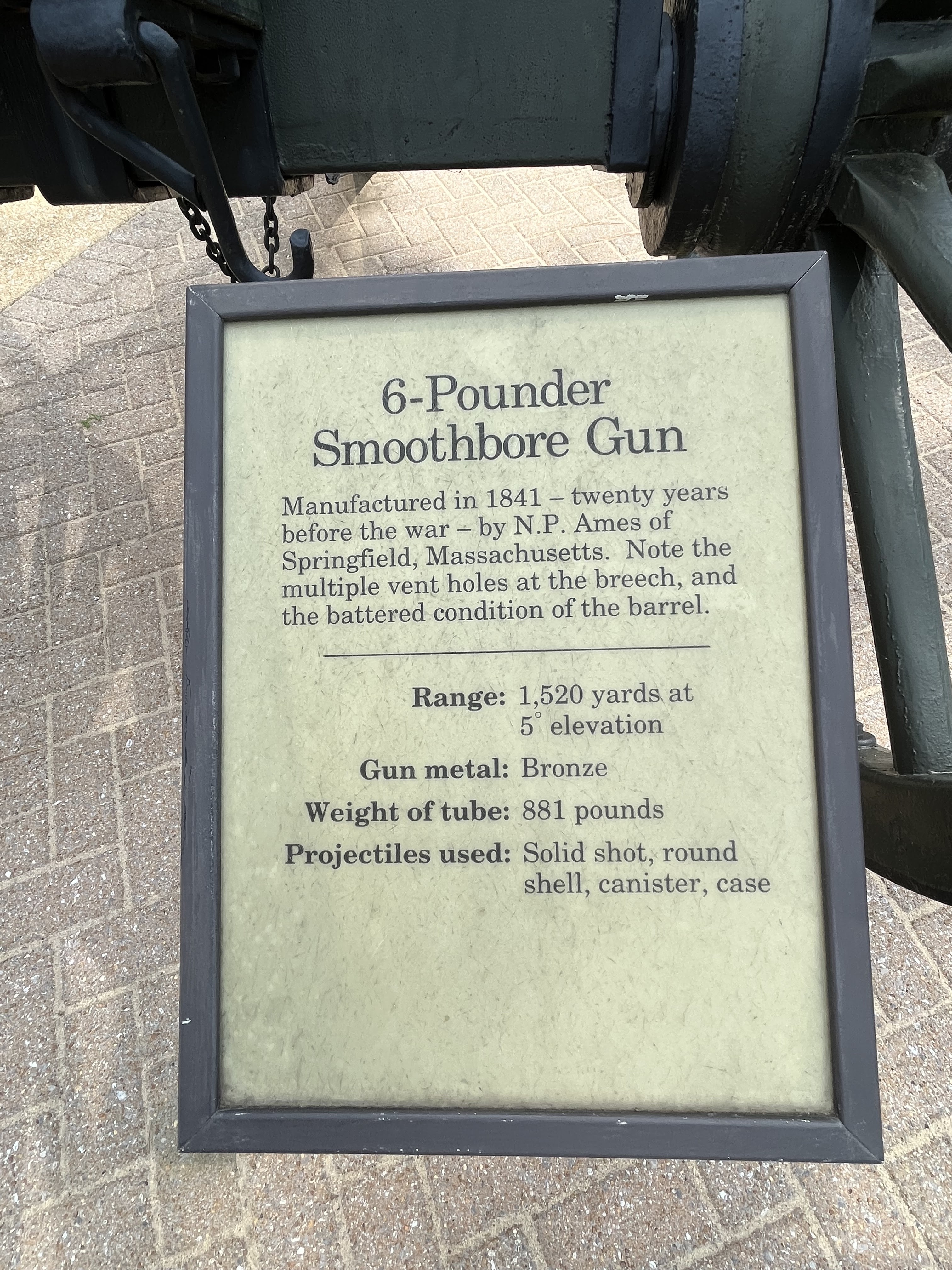
More pictures from my visit to the Battle of Chickamauga National Battlefield. Outside of the Visitor Center is an excellent display of the artillery pieces that were used in the battle, and basically what you would see in the field for any ACW battle (I'm not referring to siege guns, coastal fortifications, etc.). I'll let the pictures speak for themselves.


Yep. My shadow. I couldn't get the Sun to move fast enough.