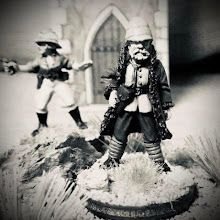
We have him securely cuffed in the chest and he will never escape . . . BWAH HAH HAH!
This is the year of the big travel - which I didn't know when I put my hobby plans together! As a result of travelling I've been able to keep up with my watercolors with my travel kit but miniature painting is another story. In between trips, and also with traveling, I was looking for smaller and/or solo board games with miniatures. I discovered the game series Unmatched from Restoration Games.
 "Nazi scum! No one can keep Harry Houdini imprisoned!"
Unmatched is a highly(!) asymmetrical miniature fighting game for two or four players. Each hero is represented by a unique deck designed to evoke their style and legend. Tactical movement and no-luck combat resolution create a unique play experience that rewards expertise, but just when you've mastered one set, new heroes arrive to provide all new match-ups. And then there is their Pulp set Tales to Amaze for solo and coorperative play that features . . . ahh, but that will be another future post.

The figures themselves are grey hard plastic that can be kept in their color marker stand or easily detached to provide a 25mm round base.

The best part - they are compatible with other 28mm figures. Above you can see the Houdini figure compared to "Sam" from Copplestone Castings. I've been impressed by detail and animation of the 8 figures I have acquired so far; I just wish I had noticed the mold lines on Houdini before I started painting. Oh well. With Houdini it appears he has been modeled with the famous "Daily Mirror" handcuffs which is a nice touch.


I also decided when I painted Houdini that I wanted to give him a haggard and worn look on his face - reading about his escapes are incredible and he was clearly exhausted after many of them.


I'm not sure if the Great Escape Artist will join "The Search for Charlie" but he will be definitely be showing up in future games not to mention Unmatched.