As an Amazon Associate I earn from qualifying purchases

Sunday, February 27, 2011

Patrick Rambaud's The Battle: Lost in Translation?

The Battle, by Patrick Rambaud is a historical novel about the Battle of Aspern-Essling which takes place in 1809 as part of the War of the Fifth Coalition. The novel, which is written in French, was awarded the the Prix Goncourt (prize for for French Literature) and another French literature prize the Grand Prix de l'Academie francaise in 1997. Since I don't know how to read French, I read the 2001 translation by Will Hobson.

The Battle of Aspern-Essling is possibly Napoleon's first defeat( depends on the historian - did he lose or was it a draw?). It is obvious that the novel was well researched . . . but, it really did nothing for me. If you know nothing about the War of the Fifth Coalition, if you know nothing about the events of the age, if you know nothing about the Battle of Aspern-Essling - well, you are out of luck. The book just starts, and it just ends with no context of what is happening in Europe or the forces that are at play. In fact, it just seems to be parts of the battle strung together to provide a narrative - but I'm not sure the purpose of the narrative. Though written from a French perspective, it gives you no insight at all about the Austrian personalities or forces.

The novel does follow many French historical figures during the battle, most notably Colonel Louis Francois Lejeune, who during the battle was one of Marshal Berthier's aide-de-camps (ADC). Later (not in the novel) Lejeune would become Marshal Davout's ADC and was later promoted to general de brigade. As a side note, Lejeuene designed the distinctive uniforms with red shakos and red paints that Berthier's ADC's wore and was one of the great battle painters of his age.

In the novel, Lejeune barely has a personality, which is saying a lot considering that none of the other historical figures have a personality. Every French marshal and general in the book seems the same; and, if I did not know who they were, I would not have been able to tell them apart in the plot except for their names. Each marshal or general has facts about them recited to give "background" and they all seem to speak with the same mannerisms and lack of personality.

Rambaud attempts to give what it was like to be a common soldier during the battle; the confusion, the fear and the "why" are we fighting. I don't know. I just did not think it was a good book. I have experienced this feeling before with translated works - maybe the meaning and skill of the book was lost in translation.

I returned the book to the library today and lo and behold, I checked out The Battle, A New History of Waterloo by an Italian writer, Alessandro Barbero, translated by John Cullen. Hopefully this book won't suffer from translation issues.

Saturday, February 12, 2011

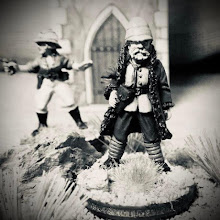
Sepoy: Wargames Rules for the Indian Mutiny

The internet has been a great resource for wargamers and I recently had the pleasure of "meeting" in the blogosphere Mr. Graham Evans. Graham is the author of Sepoy, one of my all time favorite wargames rules. Based on the English Civil War rules File Leader, by Pete Berry, the action is based around the company which is represented by six figures for infantry and three for cavalry. Due to the command and control system, Sepoy is an ideal multi-player game as one player can represent the mutineers (and will probably "lose" the game) and the other player or players will have officer figures representing them and their command and control on the tabletop battlefield.

Now I put "lose" in apostrophes on purpose; even though the mutineer player will probably lose they can have a lot of fun doing so! The pressure is on the British players to win with minimal casualties as their forces in the game and historically are much smaller than the mutineers.


One of my favorite features of the game is the Incident table. The Incident table affects the British officer figures on the table and their casualties can be quite dramatic and worthy of mention in dispatches! If the British players are not careful, their will be no heroic figure left with the stiff upper lip to lead Victoria's forces to victory.


The rules can cover every action that I have read about the mutiny from raids, open field battles, siege actions, escort duty, etc. Games are supposed to be fun and these rules fit the bill.

If you want to read how the rules came about, you can read about it here at Graham's blog Wargaming for Grownups.

Tuesday, February 8, 2011

Dog Fight: Starship Edition: New Artwork for Obstructed Card

New Artwork


Occasionally new artwork is acquired for cards which would obviously benefit from it. The MOVE card "Obstructed" allows a player to remove their ship from the board entirely for a brief time. This has the benefit of making your ship immune to any act which occurs on the map.

"Obstructed" is available in Booster Pack 9: Advanced Tactics 1, which is also the only release including the very rare EQUIP card Reactive Armor: Electromagnetic.

visit the official website for Dog Fight: Starship Edition

Saturday, February 5, 2011

Wargaming Quote of the Week

Saw this great signature for Dameon13 on the Flames of War forum:

If you take minimum sized platoons, expect minimum sized results. Adding more terrain is not a step towards becoming a better player. Call it what you want, they are still toy soldiers and you are still playing with them.

Brilliant! This guy has the right attitude.

Monday, January 31, 2011

New Exclusive Cards for Dog Fight Starship Edition

Some great new cards from Michael Fox and Fox Games for Dog Fight Starship Edition:

Two new legendary cards have been added to the exclusive mail-in list. These are Shine Spark and Partial Charge.

"Shine Spark" is the second Legendary card released exclusively for the U.S.P.V. Inferno. The Inferno has a low attack power in comparison to other capital ships it is likely to encounter. It was one of the first vessels humans made specifically for off-world combat.

Due to its low offensive capabilities, the "Raging Inferno Blast" (available only in Deluxe Set 2) was devised by USP design engineers to take advantage of the ship's numerous armaments posted around the forward hull section. This, although helpful, was unfortunately still not enough to deal with other tactics utilized by enemy heavy ships.

But the Inferno has one feature its contenders lack: a massive power core capable of powering two heavy combat vessels of its size. Thus, the "Shine Spark" was developed to fully utilize the ship's energy flow to totally overwhelm any opponent.

A team of two F.A.S. capital ships experienced the first combat demonstration of the Shine Spark's full capability in 2094. After witnessing the obliteration of an Intrepid class, the captain of the second ship coined the notable warning of the Inferno: "Old, yes. Weak, no." That ship's communications went silent soon after the first. There is rumored to be video of the Shine Spark in its final testing phases, but none has been recovered of its action in combat.

The next legendary card released was created for the F.A.S. Intrepid. The first legendary card created for the Intrepid class was "Colossus Cannon" (available only in Deluxe Set 1). The Colossus Cannon is a fierce weapon but takes an unusual amount of time to fully charge. This delay proved catastrophic in combat since it signalled to enemy vessels to move in quickly before the cannon can release its deadly discharge.

Recently, after his captain was killed in combat, the first officer of one of the Intrepids attempted to fire the ship's main cannon before it was fully charged. The enemy ship was closing in before the imminet blast but was caught by surprise when a less powerful, but still devastating blow was launched by the cannon long before expected. It is now called the Amadi maneuver, after the nickname given to the innovative young captain by his greatful crew. If you learn the Intrepid approaching is captained by Amadi, know that death approaches with him.


see the full exclusive main-in list here