As an Amazon Associate I earn from qualifying purchases

Monday, June 22, 2026

Epic Revolution Part 21: Hessian Jägers

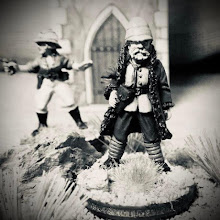
"Rifles clean and Jägers ready for action mein Generalmajor."

The Hessians were German soldiers who served as auxiliaries to the British Army during the American Revolutionary War, primarily from the states of Hesse-Kassel and Hesse-Hanau. Approximately 30,000 to 37,000 Hessians fought in the war, making up about 25% of British land forces. Twenty-five percent! Why are listed as auxiliaries? The common misconception is that the Hessians were mercenaries - NO, NO, NO! (That's the Army Colonel and Military Historian in me coming out.) 

There are 5 individual hard plastic Jägers on each British Allies sprue. The horn player is a nice touch.

Hessians were legally distinguished as auxiliaries. Whereas mercenaries served a foreign government on their own accord, auxiliaries were soldiers hired out to a foreign party by their own government, to which they remained in service. Morale was generally high, and soldiers were said to take pride in their service. Officers were usually well educated, and unlike most European armies, promoted on the basis of merit. Soldiers were paid relatively high wages, and their families were exempt from certain taxes.

About 5,000 of the Hessian soldiers who survived the American Revolutionary War chose to remain in America. Many returned with their families after the war.

Hessian jägers were elite, specialized German sharpshooters who served as part of the British forces during the American Revolutionary War. They were known for their distinctive green uniforms and use of rifles, which provided greater accuracy than standard muskets.

The field Jäger Corps of Hesse-Kassel was formed as part of the Hessian contingent provided under the subsidy treaty signed at Kassel on January 15, 1776, which committed Hesse-Kassel to furnishing fifteen infantry regiments, four grenadier battalions, three artillery companies, and two companies of Jäger to British service in North America. The two initial companies proved so effective that a supplementary treaty in December 1777 expanded the Jäger establishment from 260 to a nominal 1,067 men, and by the summer of 1777 the corps had grown to five foot companies and one mounted company under Lieutenant Colonel Ludwig Johann Adolf von Wurmb. The corps returned to Hesse-Kassel in 1784, with its journal recording the end of service on April 20 of that year, after which the formation was formally disbanded. As to be expected of an elite unit, they fought in all of the theater of operation of the AWI.

The corps was organized in foot companies and one mounted company, with the riders used for rapid movement rather than cavalry combat. Each Jäger was armed with a rifled short-barreled Büchse (hunting rifle) of roughly .52 caliber, giving them significantly greater accuracy and range than line infantry armed with smoothbore muskets, and each also carried a straight-bladed short sword known as a Hirschfänger for close-quarters combat, as the rifle could not accept a standard bayonet. The corps wore distinctive green coats with red cuffs, collars, lapels, and turn backs, and black tricorne hats, setting them visually apart from the blue-coated Hessian line infantry and earning them the nickname "Grünröcke" (Green Coats) among both allies and enemies.

Other Jäger units:

1. Creuzbourg's Jäger Corps had 4 companies and served in upstate New York and Canada.

2. 2nd Anspach-Bayreuth Jäger Company served primarily in the Southern Campaign.

3. Brunswick Jäger company which served during the Saratoga Campaign.


I "lucked" into my Hessian units when I purchased The August 2025 issue of Wargames Illustrated which included one of the four Epic Revolution! sprues as a freebie. I actually had 2 sprues of the British Allies so I was able to make a two stand unit of Jägers. It was these 2 free sprues that got me started on my Epic Revolution! project.

Thursday, June 18, 2026

Epic Revolution Part 20: The 2nd Spartan Regiment of Militia

Brigadier General Daniel Morgan, along with Major General Nathaniel Greene, review the 2nd Spartan Regiment of Militia. 

I served as a senior Infantry officer in the US Army for 24 years with numerous combat tours. Even so, I am still amazed at the men and women that founded this great country. Our forefathers were tough - but real people; with loss and triumph. It's been almost 250 years of freedom (wipes tears from his eye). Okay, let's talk about toy soldiers.

As the regimental flag of the 2nd Spartan Regiment of Militia, this banner is a rare surviving artifact from the war in South Carolina and the American Revolution. Many questions about the dog and snake painted on this flag remain unanswered. The dog may be a reference to Shakespeare's Othello, which mentions a "spartan dog" as a representation of a bloodthirsty man. American Revolutionaries often used the rattlesnake to symbolize resistance to British authority.

By the end of 1778, the Revolutionary War in the South reached a bloody turning point. Violence between Loyalist and Revolutionary forces increasingly targeted non-combatants and civilians.
Just before the New Year, British forces captured Savannah, Georgia. In order to increase protection for its population, South Carolina’s revolutionary government created a new regiment of militia. 

The 2nd Spartan Regiment of militia served in dozens of battles across the state from 1779 until the end of the war in 1783. Individual companies, battalions, or individual members of the regiment were present at Stono Ferry, Hanging Rock, Musgrove’s Mill, King’s Mountain, Ninety-Six, Eutaw Springs, and dozens of other skirmishes. Also known as the “Fair Forest Regiment” and led by Colonel Thomas Brandon, its men experienced the brutality of a civil war.


The militiamen who served in the 2nd Spartan Regiment reflected the diverse society of the South Carolina backcountry they came from. John Biddie (or Biddle), a free man of African descent originally from Virginia, volunteered for service with the regiment. He served with the unit until the Battle of Cowpens in 1781. 


Aquila Hollingsworth, born to a Quaker family in Delaware, moved to South Carolina and was expelled by the Quakers in 1776, possibly because of his pro-Revolutionary stance. He joined the regiment in May 1780 as a horseman and was killed at Cowpens. His brother and father served by his side. Joseph Hughes, a teenaged South Carolinian, fought in all of the regiment’s major battles and rose to the rank of captain.


I was originally going to paint the flag of the 2nd Spartan Regiment of Militia and then I noticed that one of the banners that came with the Warlord Epic Revolution boxes was similar. So I go lazy! Colonel Thomas Brandon kept the regimental flag of the 2nd Spartans in a wooden box in the years following the Revolutionary War. An inscription inside the case tracks the subsequent owners through the 1900s.

Colonel Thomas Brandon leads the militia of the 2nd Spartan Regiment.

The militia sprues from Warlord are easier to paint than I thought. I stuck to primarily various browns using Citadel Contrast paints with the occasional blue Continental jacket thrown in for good measure so don't be intimidated!


Tuesday, June 16, 2026

Epic Revolution Part 19: Lieutenant Colonel James Webster

LTC Webster (local rank Brigadier General) scouting the terrain at Beatty's Ford in North Carolina in the pursuit of Brigadier General Daniel Morgan.

Born in 1743 to an Edinburgh minister, James Webster entered the 33rd Regiment of Foot as a Lieutenant on May 10, 1760, steadily rising through the ranks to become lieutenant colonel under Cornwallis. He took command of the regiment when Cornwallis received a promotion to lieutenant general in January 1776 and, the following month, Webster and his regiment left England, bound for service in North America.

LTC Webster consults with Lord Cornwallis during the Southern Campaign.

Webster led the 33rd Regiment in the New York and Philadelphia Campaigns, as well as at the Battle of Monmouth. The 33rd Regiment had the reputation as the best drilled and finest regiment in the army. With the stalemate in the North, Webster and the 33rd headed south for the capture of Charleston, SC and the Southern Campaign under Cornwallis.

Webster and the 33rd Foot. Webster wears the uniform of a senior officer with the red facings of the 33rd Regiment.

As the British entered the interior of South Carolina, the 23rd Regiment of Foot (Royal Fusiliers) joined Webster to form a demi-brigade. Webster's regiments formed Cornwallis's right at the Battle of Camden on August 16. Facing inexperienced Virginia militia, Webster smashed through the Patriot line, wheeling his men into position to further engage Continentals under Maj. Gen. Johan de Kalb. This maneuver contributed to the disintegration of the Patriot force still on the field and led to a British victory. From then on, Webster commanded Webster's Brigade consisting of the 23rd Foot and the 33rd Foot.


At the battle of Guilford Courthouse on March 15, 1781, Webster's regiments advanced on the British left, while Greene formed his army in three successive lines, the first two made up of militia, the last of Continental Regulars. As the British approached the first line, Webster "rode forward in front of the 23rd" wrote Roger Lamb, a sergeant in the regiment, "and said, with more than even his usual commanding voice, which was well known to the brigade, "Come on my brave Fusiliers [sic]".

Webster leads his brigade toward Guilford Courthouse, North Carolina.

At some time during the battle, Webster sustained an injury to his leg, to which he succumbed weeks later. Devastated by the loss, Cornwallis penned a letter to Webster's father. "It gives me great concern to undertake a task which is not only a bitter renewal of my own grief but a violent shock to an affectionate parent," the general wrote. "Your son fell nobly in the cause of his country, honored and lamented by all his fellow soldiers; that he led a life of honor and virtue, which must secure him everlasting happiness."

The figure I painted as Webster will be one of my brigade commanders and it is no coincidence that it will lead the 23rd Regiment and 33rd Regiment as a representation of Webster's Brigade in the Southern Campaign. The figure is from the British Brigade box and I wanted to have a commander that was not in the usual blue facing colors of a British general officer thus the facings of the 33rd Regiment.