As an Amazon Associate I earn from qualifying purchases

Saturday, May 2, 2015

Dux Bellorum: Twilight of Empire

Nothing like a new job and business travel to keep you off the tabletop but I was able to recently play a game of Dux Bellorum.
 

Dux Bellorum is a great, fast past set of rules written by Daniel Mersey and published by Osprey Wargames that allows you to re-fight the Dark Ages in Britain from the Late Roman period up to the year 800 AD.


Armies are element based and can be of any scale; movement and ranged combat is my base width (BW) allowing any figure scale or basing mechanism. In issue 62 of Wargames Soldiers & Strategy I read a Dux Bellorum article by Steve Jones in which his armies are mounted on 120 mm width bases but he uses 4 inches as the BW for convenience.  I decided to follow suit, mounted the armies on their bases and created my own measuring stick with a wooden dowel.

 My measuring stick.  Nothing fancy but it gets the job done.

The battle fought is a fictional encounter between a Late Roman Army catching up with Saxon raiders ravaging the province of Britannia.The scenario would be the Annals Battle with each side having 32 points and a simple goal: Rout the enemy.

The Late Roman Army: I envisioned this force as the cream of the Roman army stationed in Britain with excellent cavalry and solid infantry.

Late Roman Army.  This is the force minus one of the Shieldwalls.

1 Mounted Companions: 5 points.  This is the Roman general and his personal retinue of Huns!
1 Cataphracts: 6 points. Well, I have some painted so why not?  
1 Noble Riders: 5 points.  Veteran and well mounted cavalry.
1 Mounted skirmisher: 2 points.  Armed with javelins, these local auxiliaries have been tracking and keeping an eye on the Saxon dogs.
3 Ordinary Shieldwall: 9 points. Solid Roman Infantry.
2 Foot Skirmishers: 2 points.  One unit armed with javelins and the other with bows.

 Late Roman skirmishers.

Strategy and Tactic: Imposing Horseman: 3 points. Adds +1 die when the cavalry contact (charge) the enemy. Cataphracts and mounted skirmishers do not get the bonus.

 Hoping to ride down the Saxons.

Early Saxon Army:  An elite raiding force trying to make a get away.

My Saxon Army . . . but no skirmishers for you this time!

1 Foot Companions:  5 points. Warriors of course!
3 Noble Warriors: 15 points.  Extra armor, skill with weapons and flags.
3 Ordinary Warriors: 9 points.  We can fight.  Just point us in the right direction.

 The Saxon Warlord and his Companions.

Strategy and Tactic: Loyal: 3 points. One of the Noble units increases its Bravery to 10 for the entire game. 

The Loyal relatives of the Warlord get to carry the big flag.

Next up:  The Battle, why you should not charge solid infantry with your cavalry, skirmishers and much more.




Sunday, April 5, 2015

He Has Risen Indeed!


Saturday, April 4, 2015

Because it's fun!

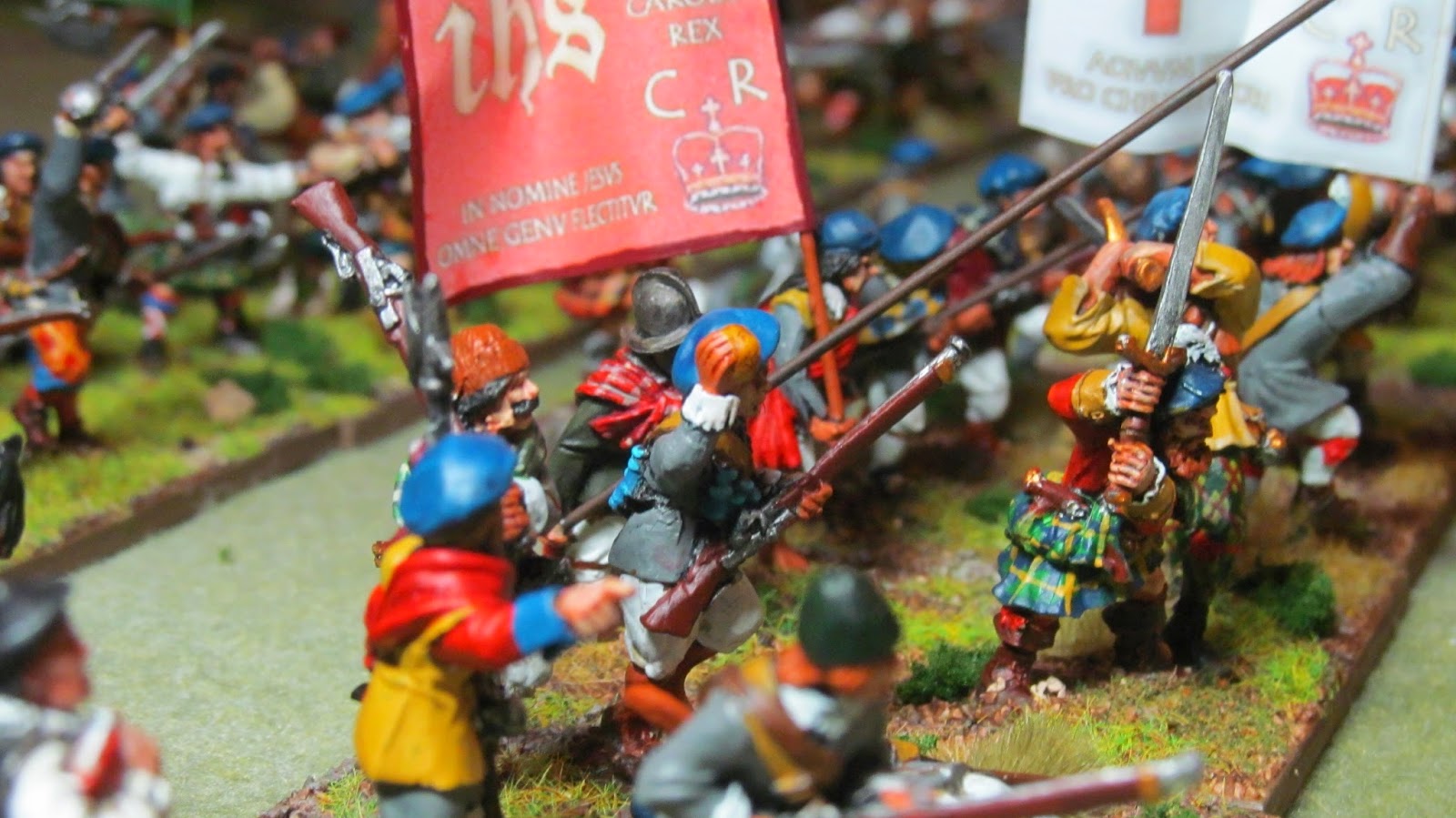
I love this hobby . . . and my new interest in the English Civil War!  Some recent pictures using Victory Without Quarter.


Friday, April 3, 2015

World War II "Tactical" Higher Commanders

Flames of War is a game that usually pits a company sized element with support against another similar sized force.  Occasionally battalion commanders and higher get involved direct fire engagements just as in real life.

German Higher Command Auction


Panzer IV tank with Major Von Luck (late war) and a dismounted Major Von Luck with Kubelwagen. There is also Generalmajor Remer with Kubelwagen, dismounted Tiger ace Michael Wittman and one dismounted German officer who I can not remember his name!  The Michael Wittman and single panzer officer can also be used as bail out crew markers.


German World War II Late War Pioneers (Combat Engineers)

A combat engineer (also called field engineer, pioneer or sapper in many armies) is a performs a variety of construction and demolition tasks under combat conditions.

 German Pioneer Auction.


 The combat engineer's goals involve facilitating movement and support of friendly forces while impeding those of the enemy. Combat engineers build, repair and maintain buildings, roads and power supplies.


 They employ explosives for construction and demolition projects, and clear minefields using sometimes specialized vehicles. Such tasks typically include constructing and breaching trenches, tank traps and other fortifications, bunker construction, bridge and road construction or destruction, laying or clearing land mines and other physical work in the battlefield.


Usually, a combat engineer is also trained as an infantryman and combat engineering units often have a secondary role fighting as infantry . . . or as we used to call them: an infantryman with a shovel!


Seriously, a good combat engineer is worth his weight in gold.